Month 1: Delivering value, building trust, managing your first sprint
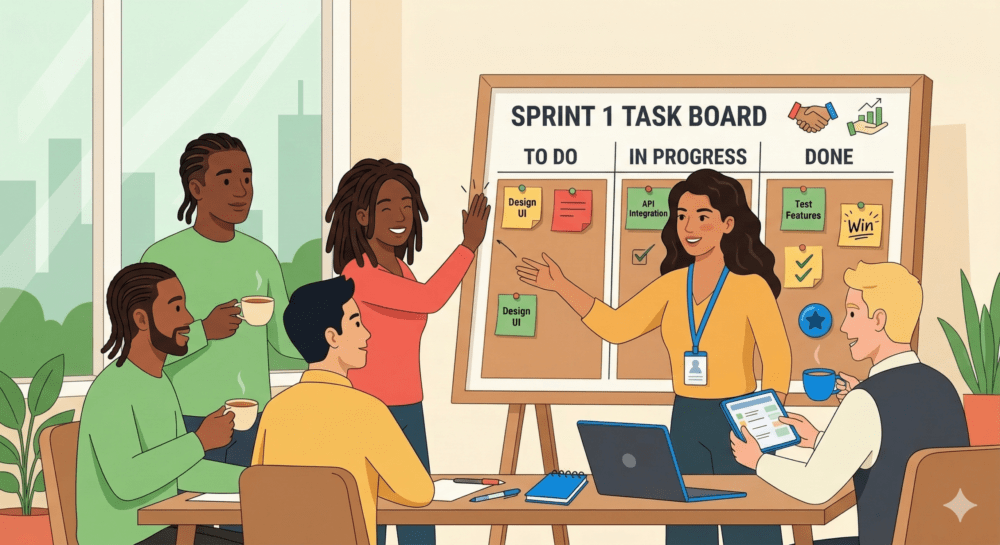
Your first sprint as an Agile Project Manager is not about being perfect. It’s about helping the team focus, removing confusion, and making sure everyone understands what they’re trying to achieve. Whether you’re working in a hospital, a charity, a tech startup, a school, or a global company, the goal is the same: deliver something useful and build trust through consistency.
Value in Agile doesn’t always mean a big feature or a shiny product. Sometimes value is clarity, a solved problem, or a small improvement that makes someone’s day easier. Trust grows when people see that you support them, communicate clearly, and help the team move forward.
1. What “Delivering Value” Really Means
In everyday life, delivering value is simple. If you organise a family event, value might be making sure everyone knows the plan. If you run a small business, value might be serving customers quickly. If you volunteer, value might be helping the team stay organised.
In Agile teams, value works the same way. It could be:
- A small feature that solves a real problem
- A clearer process
- A decision that unblocks the team
- A document that helps everyone understand the work
- A simple improvement that saves time
Value is anything that helps the team or the customer move forward.
2. How to Build Trust as a New Agile Project Manager
Trust isn’t built through big speeches or fancy tools. It’s built through behaviour.
Be reliable
If you say you’ll follow up, follow up. If you say you’ll check something, check it.
Communicate clearly
Share updates in simple language. Avoid long explanations. Make things easy to understand.
Support the team, don’t control them
Ask what they need. Remove obstacles. Make their work easier.
Stay calm when things change
Agile environments shift quickly. Your calmness becomes the team’s calmness.
Trust grows when people feel safe working with you.
3. Managing Your First Sprint (Step by Step)
Your first sprint doesn’t need to be complicated. Here’s a simple structure that works in any organisation.
Step 1: Clarify the sprint goal
A sprint goal is a short statement that explains what the team wants to achieve. Example: “Improve the login experience” or “Prepare the community event materials.”
Step 2: Review the backlog
The backlog is the list of tasks. Work with the Product Owner or team lead to choose the most important items.
Step 3: Support the team during the sprint
Your role is to keep things moving. Check in, remove blockers, and make sure everyone understands the plan.
Step 4: Keep the workflow visible
Use a simple board with:
- To Do
- In Progress
- Done
This helps everyone stay aligned.
Step 5: Celebrate progress, even small wins
A sprint is successful when the team delivers something useful — not when everything is perfect.
4. What This Looks Like in Real Organisations
In a hospital:
A sprint might focus on improving patient check‑in forms.
In a charity:
A sprint might prepare materials for a fundraising event.
In a local council:
A sprint might streamline a public service process.
In a tech startup:
A sprint might deliver a small feature or fix a bug.
In a school or community centre:
A sprint might organise a workshop or update learning materials.
The principles stay the same everywhere: clear goals, small steps, teamwork, and communication.
Practical Application (Walk‑Through Together)
Let’s imagine you’re managing your first sprint.
The team wants to improve how customers sign up for a service.
You would:
- Agree on the sprint goal: “Make the sign‑up process easier.”
- Choose the key tasks:
- Review the current form
- Remove unnecessary steps
- Test the new version
- Update the instructions
- Support the team: Check in daily, remove blockers, keep communication clear.
- Track progress: Move tasks across the board as they’re completed.
- Review the outcome: What improved? What still needs work?
This is a complete sprint — simple, structured, and valuable.
Your Activity
Write down:
- One small goal you could turn into a sprint
- Three tasks that would support that goal
- One way you can build trust with your team this week
This helps you practise delivering value from day one.
One‑Sentence Summary
You deliver value and build trust by keeping things clear, supporting the team, and guiding your first sprint with simple, steady steps that help everyone move forward.