Common Agile Project Management interview questions & answers
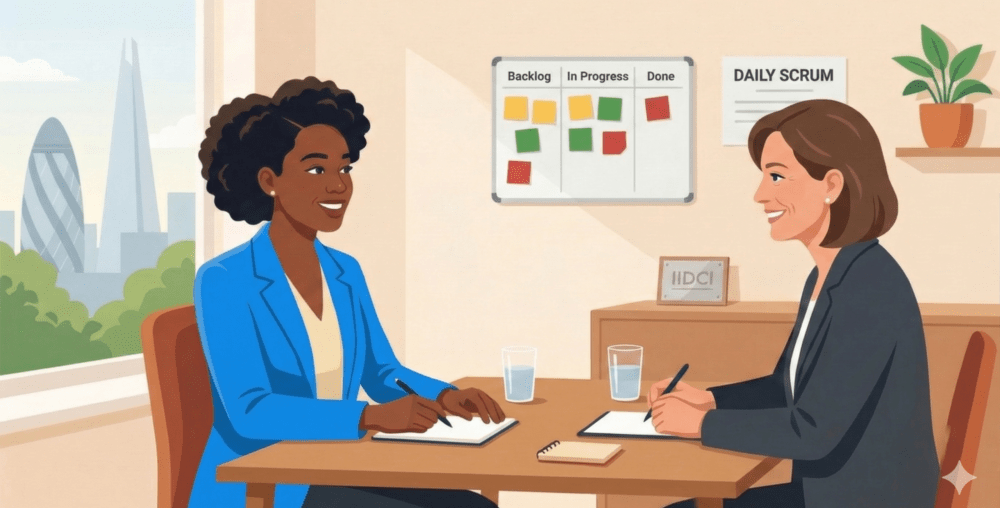
Interviews can feel scary, especially if you’re new to the job market or changing careers. Think of this guide as me sitting with you over a cup of tea, helping you prepare calmly and confidently. Every answer uses simple human language, real‑life examples, and the STAR method so you can speak clearly without feeling overwhelmed.
What Is the STAR Method?
The STAR method is a simple way to answer interview questions that ask you to tell a story — especially those that begin with:
- “Tell me about a time when…”
- “Give an example of…”
- “How did you handle…”
Instead of rambling or freezing, STAR helps you stay calm and clear.
It stands for:
- S – Situation: What was happening? Set the scene.
- T – Task: What was your role? What did you need to do?
- A – Action: What steps did you take? What did you actually do?
- R – Result: What happened in the end? What did you achieve or learn?
Why It Works
Interviewers love STAR because it shows:
- You can think clearly under pressure
- You understand your role in a team
- You can reflect and learn from experience
It’s used in interviews across industries — from tech startups to hospitals, charities to government offices.
1. “Tell us about yourself.”
This is your warm‑up question. They’re not asking for your life story. They want to know:
- Who you are professionally
- What you’ve done that relates to Agile
- Why you’re excited about this role
How to answer (simple structure):
- Present – Who you are now
- Past – What you’ve done
- Future – Why you want this role
Example Answer (Beginner‑Friendly):
“I’m an organised and people‑focused person with a growing passion for Agile ways of working. In my previous roles, I’ve always enjoyed helping teams stay on track, solve problems, and deliver things on time. Recently, I completed an Agile Project Management course where I learned how sprints, stand‑ups, and user stories work in real organisations like councils, NHSS teams, and tech companies. I’m excited about this role because it gives me the chance to support a team, keep work flowing smoothly, and continue growing as an Agile professional.”
2. “Why Agile?”
They want to know why you chose this path.
Example Answer:
“I like Agile because it focuses on people, teamwork, and delivering value quickly. It reminds me of how we solve problems in everyday life — break things down, try something small, learn from it, and improve. Agile feels natural to me, and I enjoy the structure it gives to fast‑moving work.”
3. “What is a Sprint?”
Explain it like you’re teaching a friend.
Example Answer:
“A sprint is a short, focused period — usually 1–2 weeks — where the team agrees on a small set of work they can finish. It’s like saying, ‘For the next week, we’re only focusing on these tasks.’ At the end, the team reviews what they’ve done and plans the next sprint.”
4. “Tell us about a time you worked in a team.” (STAR)
Situation
“At my previous job, our team needed to organise a community event with very little time.”
Task
“My role was to coordinate everyone’s tasks and keep us on schedule.”
Action
“I created a simple checklist, held quick daily catch‑ups, and made sure everyone knew what they were responsible for.”
Result
“We delivered the event on time, had great attendance, and my manager praised the teamwork.”
5. “Tell us about a time you handled a difficult stakeholder.” (STAR)
Situation
“In my last role, a colleague was unhappy because they felt left out of decisions.”
Task
“I needed to rebuild trust and improve communication.”
Action
“I booked a short meeting, listened to their concerns, and agreed to share updates more regularly. I also invited them to planning sessions.”
Result
“They became more engaged, and our collaboration improved.”
6. “How do you prioritise work?”
Example Answer:
“I look at value, urgency, and impact. In Agile, we often use simple tools like MoSCoW (Must, Should, Could, Won’t) or ask, ‘What helps the user the most right now?’ I also check with the Product Owner to make sure we’re aligned.”
7. “Tell us about a time you managed changing requirements.” (STAR)
Situation
“During a small project, the client changed their mind halfway through.”
Task
“I needed to adjust the plan without delaying everything.”
Action
“I broke the new request into smaller tasks, discussed the impact with the team, and updated our timeline.”
Result
“We delivered the updated version on time, and the client was happy.”
8. “What is a user story?”
Simple Answer:
“A user story is a short sentence that explains what a user needs and why. For example: ‘As a student, I want to reset my password so I can access my account.’”
9. “Tell us about a time you solved a problem quickly.” (STAR)
Situation
“Our team’s shared folder stopped working before a deadline.”
Task
“I needed to help the team keep moving.”
Action
“I created a temporary shared Google Drive and moved the key files there.”
Result
“The team continued working without delays, and we met the deadline.”
10. “How do you support a team during a sprint?”
Example Answer:
“I help remove blockers, keep communication clear, and make sure everyone knows the sprint goal. I also check in regularly and encourage collaboration.”
11. “Tell us about a time you improved a process.” (STAR)
Situation
“Our team kept missing small tasks.”
Task
“I wanted to make our workflow clearer.”
Action
“I introduced a simple Kanban board with To Do, Doing, and Done columns.”
Result
“We became more organised, and tasks stopped slipping through the cracks.”
12. “What is your biggest strength?”
Example Answer:
“My biggest strength is staying calm and organised, even when things change. Agile environments move fast, and I’m good at helping teams stay focused.”
13. “What is your weakness?”
Example Answer:
“I used to take on too much myself, but I’ve learned to ask for help earlier and share work more effectively.”
14. “Why should we hire you?”
Example Answer:
“I bring strong organisation, a people‑first mindset, and a genuine passion for Agile. I’m committed to learning, supporting the team, and helping deliver value quickly.”
15. “Do you have any questions for us?”
Always say yes.
Good questions:
- “What does success look like in the first 3 months?”
- “How does your team run sprints?”
- “What tools do you use for Agile work?”
Memory Tricks for Learners
- Use the STAR method for any story question
- Keep answers short — 1 minute max
- Use real life — family, community, volunteering, uni, part‑time jobs
- Practice out loud — your voice builds confidence
- Think of 3 stories you can reuse for many questions, and any interview.
Practical Walk‑Through (Let’s Do One Together)
Imagine the interviewer asks:
“Tell us about a time you handled pressure.”
You pause, breathe, and use STAR:
- Situation: “At my retail job during Christmas, queues were long and customers were stressed.”
- Task: “I needed to keep service moving and stay calm.”
- Action: “I organised the queue, communicated clearly, and helped colleagues when they got stuck.”
- Result: “We reduced waiting time, and my manager thanked me for staying calm.”
That’s it. Clear, simple, confident.
Your Activity
Write one STAR story from your own life. It can be from work, volunteering, family responsibilities, or school. Keep it short and human.
One‑Sentence Summary
Agile interviews are simply conversations where you show how you think, how you work with people, and how you stay calm — and the STAR method helps you tell your story with confidence.